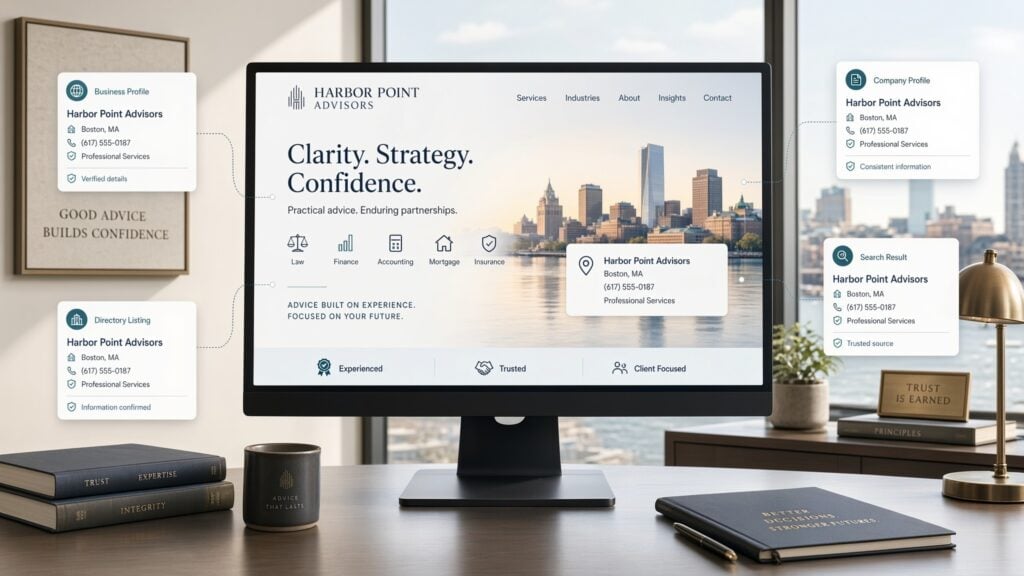
AI search does not simply choose between your website and directory listings. It can use information from both. Your website is the primary source you control for explaining your services, locations, expertise, and people. Relevant directories and third-party profiles provide outside context that can help confirm who your firm is. When important information aligns across sources, your business is easier to understand and verify.
The Core Answer: What Does AI Search Trust More, Your Website or Directories?
The better question is not whether AI search trusts your website or directories. It is whether the information available about your firm forms a clear and consistent picture.
Your website and third-party profiles play different roles.
| Signal | Your Website | Directories and Third-Party Profiles |
| Business identity | Primary first-party explanation | Outside reference to the same entity |
| Service detail | High level of control and depth | Usually summarized or categorized |
| Expertise | Bios, service pages, articles, FAQs | Credentials, categories, reviews, or profile data |
| Location information | Locations and service areas you publish | Independent location and contact references |
| Content control | High | Limited or platform-dependent |
| Confirmation | Your own claims | Information published outside your domain |
| Update control | Usually direct | Varies by platform |
| Best role | Foundation | Corroboration and context |
Google provides a useful example of why both kinds of information matter. Its documentation says information used in local business profiles can come from publicly available web content, including a firm’s official website, as well as licensed third-party data, user contributions, business owners, and Google’s own interactions with a business.
Google’s AI Search documentation also explains that AI Mode can break a question into subtopics and search across multiple data sources before generating an answer.
That does not mean Google documents a process in which every directory is literally checked against your website before every AI answer. It does mean that search systems have access to more than one source of information about a business.
For professional firms, the practical lesson is straightforward: make those sources tell the same accurate story.
Key Takeaways
- Your website is the foundation. It gives you the greatest control over how services, expertise, locations, professionals, and client needs are explained.
- Third-party profiles provide outside context. They can reinforce identity, category, location, credentials, reputation, or professional relevance.
- Consistency matters more than an arbitrary listing count. There is no documented magic number of directories required for AI visibility.
- Accuracy should extend beyond basic contact information. Services, categories, locations, descriptions, professionals, and website URLs can all shape how the firm is understood.
- Not every directory deserves equal attention. Relevance, accuracy, authority, audience value, and maintainability matter more than being listed everywhere.
- Neither source guarantees visibility. Search engines use many systems and factors, and AI-generated experiences can vary by query.
Neither a strong website nor accurate directory listings guarantee rankings, AI citations, or leads. Together they make a firm easier to identify and verify, for both people and the systems that organize public information.
Why Does This Question Matter More Now?
Professional firms spent years hearing that they needed a website, social profiles, business listings, review profiles, industry directories, and local citations.
Then AI search changed what the search results page looked like.
Google AI Overviews can present an AI-generated summary before a user visits a website. Google AI Mode can answer longer questions and provide supporting web links. Microsoft also integrates search content into Copilot and other grounding experiences.
That understandably creates directory fatigue.
If AI can answer a prospective client’s question directly, why should a CPA, law firm, mortgage professional, financial advisor, or insurance agency care whether an old profile on another website is accurate?
Because AI-generated answers have not eliminated the underlying web.
Google says its AI search features remain rooted in core Search systems. Its AI Mode can use “query fan-out,” searching related subtopics and data sources to assemble useful responses. Bing similarly states that SEO practices supporting content clarity, authority, indexing accuracy, and entity consistency also support grounding and citation eligibility.
In other words, AI changes the interface through which people discover information. It does not make accurate information about your firm irrelevant.
This is also why AI search needs more than a website. A website can explain your business in depth, but it exists within a larger information environment.
What Does Your Website Do That a Directory Cannot?
Your website is the strongest first-party source for explaining your firm on your own terms.
A directory profile may identify a CPA as a tax professional. The CPA’s website can explain whether the firm focuses on individual tax preparation, business tax planning, tax resolution, bookkeeping, advisory work, or a specific client segment.
A legal directory might identify an attorney’s practice area. The law firm’s website can explain the actual services provided, attorney experience, jurisdictions served, common client questions, relevant processes, and related educational resources.
The same distinction applies across Evoltra’s core professional-service industries.
A mortgage professional can explain loan scenarios and borrower needs. A financial advisor can describe planning specialties and client types while observing applicable regulatory requirements. An insurance agency can explain coverage categories, markets served, and how its team works with clients.
Your website establishes depth
Strong first-party content can answer questions such as:
- What does the firm actually do?
- Which services are priorities?
- Which professionals provide them?
- Which locations or jurisdictions does the firm serve?
- Which types of clients does it help?
- What expertise can the firm demonstrate?
- What questions can it answer better than a generic profile?
This depth matters because Google specifically recommends making important information available in textual form and creating helpful, reliable, people-first content for its search and AI experiences.
Your website is therefore not just an online brochure. It is your primary opportunity to create a detailed, structured explanation of your firm’s expertise.
If your website can look fine and still feel invisible, stronger design alone will not solve that information problem.
Takeaway: Your website gives search systems the deepest first-party explanation of who your firm is, what it does, and where its expertise belongs.
What Do Directories Do That Your Website Cannot?
A directory is valuable for a different reason: it is not your website.
That distinction matters.
Information published on your own domain is first-party information. A relevant profile, licensing page, association page, business listing, review platform, or industry directory exists outside that controlled environment.
These sources can add several types of context.
1. They can reinforce business identity
A third-party profile may repeat your firm’s name, location, phone number, website, professionals, or categories.
Google expressly states that local business information can be assembled from multiple sources, including official websites, licensed third-party data, user contributions, and Business Profile information.
2. They can provide category context
Third-party platforms often organize firms by profession, specialty, geography, credentials, or service category.
That structure can create relationships that are different from the narrative on your own site.
3. They can provide evidence outside your domain
Professional firms frequently need more than self-description.
An attorney may have bar or association information. A mortgage professional may appear in appropriate licensing or industry sources. Financial, insurance, accounting, and tax professionals can also have relevant professional or regulatory references.
Not every external profile has equal value. But credible third-party information can make it easier for users (and potentially search systems) to connect an online entity with a real professional firm.
Google’s Organization structured-data documentation reflects the broader importance of entity identification. It allows organizations to identify their official URL and reference external pages through the sameAs property.
That does not make every profile an SEO ranking factor. It demonstrates that connections between an organization and external identifying pages are part of the web’s entity structure.
Takeaway: Directories do not replace first-party expertise; their distinctive value is that they provide information about your firm outside your own domain.
What Happens When Your Website and Directory Listings Disagree?
Conflicting information creates ambiguity.
Imagine a law firm’s website says it has offices in Miami and Fort Lauderdale, while several old profiles still show a location the firm left three years ago.
Or a CPA firm’s website now emphasizes business tax advisory services while older profiles describe it only as a bookkeeping company.
Perhaps an insurance agency changed its primary phone number, a financial advisory practice changed names, or a mortgage professional moved to a different company while older profiles remained indexed.
Humans notice those discrepancies.
Search systems can encounter them too.
Google tells businesses to maintain complete and accurate Business Profile information. Its guidelines also instruct businesses to represent themselves consistently as they are recognized in the real world.
Bing goes further in its current AI-search guidance, recommending clear and consistent naming for organizations, people, products, and locations to improve grounding visibility and citation accuracy.
This is why profiles that tell different stories deserve attention.
Consistency does not mean copying every sentence
Your descriptions do not need to be identical everywhere.
The goal is factual alignment.
Core facts should agree where applicable:
- business name
- address or legitimate service-area information
- primary phone number
- website
- active locations
- professionals associated with the firm
- primary business category
- important services
- current branding
Descriptions can vary naturally by platform because different sites provide different amounts of space and context.
A website might explain an estate-planning service in 1,500 words. A profile may reduce it to a short category and description. Those sources are consistent if they describe the same underlying practice accurately.
The problem begins when they describe materially different businesses.
That produces the same type of mixed signals to Google and AI search that can make a firm’s online identity harder to interpret.
Takeaway: Consistency means agreement on core facts, not identical wording across every platform.
Why Do a Few Accurate Listings Matter More Than Dozens of Neglected Ones?
There is no documented number of directory listings that a professional firm must have to become trusted by AI search.
That is important because directory strategy is often sold as a volume game.
For a professional firm, raw quantity is a poor operating goal. A more practical objective is to maintain profiles that are:
- Relevant to the firm’s profession, location, or audience.
- Accurate about the firm’s current identity and services.
- Credible enough to provide meaningful external context.
- Visible to actual prospects or search systems.
- Maintainable when business information changes.
A firm with 100 profiles is not automatically better represented online than a firm with 15.
If many of those 100 profiles contain duplicate addresses, old phone numbers, former employees, outdated practice areas, or incorrect URLs, the additional volume creates more maintenance work without necessarily creating more useful authority.
This distinction is particularly important for professional firms because their information changes over time.
Attorneys join or leave. Mortgage professionals change organizations. Office locations move. CPAs add advisory services. Insurance agencies change carriers or markets. Financial firms revise branding or professional affiliations.
Every old profile becomes another place that may need correction.
That does not mean firms should remove accurate listings simply to reduce the number. It means directory quantity is not the strategy; relevant and maintainable corroboration is.
Takeaway: There is no magic directory count. Prioritize accurate profiles that meaningfully represent the firm’s identity, profession, location, or authority.
How Should Professional Firms Prioritize Directories Without Chasing Every Site?
Start with importance, not volume.
A practical directory review can be organized into four layers.
Priority 1: Search and business identity
Start with the major profiles and search-related business information that directly represent the firm.
Make sure your website, business name, phone, location information, core categories, and major services are current.
For U.S. firms with eligible locations or service areas, Google Business Profile deserves particular attention because Google uses Business Profile information directly in Search and Maps.
Priority 2: Profession-specific sources
Review profiles tied closely to your industry, credentials, licensing environment, or professional audience.
The appropriate sources differ for attorneys, mortgage professionals, financial advisors, CPAs, tax professionals, and insurance agencies.
Relevance matters more than collecting badges.
Priority 3: Local authority sources
Evaluate legitimate local profiles that help establish the firm’s relationship to its geographic market.
These may include local professional organizations, chambers, community institutions, business resources, or other credible local references where participation is genuine.
Priority 4: General profiles
Then address broader business profiles that have meaningful visibility, existing authority, or a realistic chance of being encountered by prospective clients.
Do not assume every directory discovered in a search deserves time, money, or attention.
A useful prioritization question is:
If this profile is inaccurate, how likely is it to confuse a prospect or contradict an important source about our firm?
That creates a much better maintenance strategy than attempting to appear on every site that accepts a submission.
For firms whose website itself lacks clear service, location, entity, or question-based content, directory cleanup should also be paired with AEO Website Optimization. External consistency cannot compensate for a vague first-party source.
What Information Should Match Across Your Website and Profiles?
Professional firms should audit more than the traditional name-address-phone checklist.
Those basics remain important, but the firm’s broader identity deserves attention.
| Information | What to review |
| Business name | Current legal/public-facing identity where appropriate |
| Address | Active office location or valid service-area setup |
| Phone | Primary customer-facing number |
| Website | Correct canonical business URL |
| Services | Current services the firm actually provides |
| Categories | Accurate description of the firm’s work |
| Professionals | Current attorneys, advisors, agents, CPAs, or loan professionals |
| Locations | No closed, relocated, or nonexistent offices |
| Description | Current positioning rather than outdated service emphasis |
| Branding | Current business identity and naming |
| Hours | Accurate client-facing availability where applicable |
Not every platform exposes all of these fields. Audit the fields that it does provide.
This broader approach also avoids a common mistake: fixing the phone number while leaving the actual business description five years out of date.
Website vs. Directories: Which Should You Fix First?
If both are weak, start with the sources that define the firm most directly.
For most professional firms, that means:
First: establish an accurate, clear website.
Second: make sure important search and business profiles reflect the same core information.
Third: correct relevant professional, local, and general third-party profiles based on their importance.
Fourth: create a process for revisiting those sources when the firm changes.
The website comes first because it allows the deepest explanation and gives the firm direct control.
But “website first” does not mean “website only.”
If an attorney changes firms, an insurance agency relocates, or a CPA practice changes its name, updating the website while leaving important external profiles untouched solves only part of the identity problem.
Likewise, correcting dozens of listings cannot compensate for a website that never clearly explains the firm’s services.
The two systems reinforce different aspects of visibility.
The Bottom Line: Your Website and Directories Have Different Jobs
Your website versus directories is the wrong contest.
Your website should be the most complete first-party explanation of your firm. Relevant directories and outside profiles can add independent context about identity, location, profession, credentials, reputation, and category.
The objective is not to make every source identical.
The objective is to make the important sources compatible.
For a professional firm, that means a prospect should not encounter one version of the business on the website, another in search results, and a third across professional profiles.
The clearer that digital identity becomes, the easier it is for people and search systems to understand what the firm does and whether it is relevant to a particular question.
If you are unsure where those signals agree, or where they conflict, the Evoltra Authority Score assessment provides a lower-friction way to evaluate your firm’s visibility foundation and identify gaps that deserve attention.
Neither a strong website nor accurate directory listings guarantee rankings, AI citations, or leads. Together they make a firm easier to identify and verify, for both people and the systems that organize public information.
Frequently Asked Questions
Do directories still matter if AI answers questions directly?
Yes, relevant third-party profiles can still matter because AI-powered search is built on information retrieved from the web and other data sources.
Google says AI Overviews and AI Mode remain connected to its core Search systems and can surface supporting websites. Google also documents that its local business information can come from official websites, licensed third-party data, users, and Business Profiles.
Directories should therefore be viewed as supporting sources, not substitutes for a strong website.
How many directories does a professional firm need?
There is no documented magic number.
A professional firm should prioritize profiles that are relevant to its profession, geography, audience, credentials, or established online presence. Accurate and maintainable information is more useful than pursuing listing volume for its own sake.
The appropriate mix will differ between a law firm, mortgage professional, financial advisor, CPA, tax professional, and insurance agency.
What if a directory shows outdated information that I cannot edit?
First determine whether the profile can be claimed, corrected, merged, or removed through the platform’s normal process.
If you cannot control it directly, document the inconsistency and prioritize other authoritative sources you can control. Make sure your website and important business profiles clearly display current information.
One outdated page does not automatically determine how a search system understands your firm, but material inconsistencies are worth correcting where reasonably possible.
Are paid directory listings worth it?
A paid listing is worth evaluating when the platform reaches the right audience, has genuine professional or local relevance, creates useful referral exposure, or provides business value beyond the label of being “listed.”
Payment itself does not make a profile authoritative.
Google specifically states that businesses cannot pay for better local ranking. Evaluate paid listings based on audience, credibility, referral value, visibility, accuracy, and cost, not on promises of guaranteed Google or AI exposure.
Does every directory listing need the exact same business description?
No.
Core facts should be consistent, but the wording can differ.
A short directory description can summarize a service that the firm’s website explains in detail. Consistency means the two sources describe the same business accurately, not that every sentence is duplicated.
Can consistent listings guarantee that ChatGPT, Google AI, or another AI system recommends my firm?
No.
Search engines and AI systems use multiple retrieval, ranking, and quality systems, and their outputs vary by query.
Accurate first-party and third-party information helps make the firm easier to understand and verify. It does not guarantee rankings, recommendations, citations, or leads.